
Mindset
Mindset
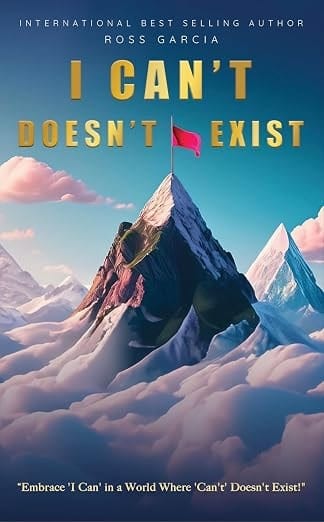
I Can't Doesn't Exist by Ross Garcia: A Book About Mindset, Belief, and Breaking Limits
Ross Garcia·
I Can't Doesn't Exist by Ross Garcia is a personal development book built around a simple but powerful idea: the words we repeat to ourselves can shape the limits we accept.
The phrase "I can't" often sounds harmless. It can become an automatic response to fear, uncertainty, failure, or a challenge that feels too difficult. But over time, constantly telling yourself what you cannot do can influence the way you think, the decisions you make, and the opportunities you are willing to pursue.
In I Can't Doesn't Exist, Ross Garcia challenges readers to question those limitations and develop a stronger mindset toward life, goals, business, relationships, and personal growth.
The title represents a mindset shift. It does not mean that every goal is easy or that obstacles should be ignored. Instead, it encourages people to stop treating difficulty as proof that something is impossible. There is an important difference between saying "I can't do this" and saying "I haven't figured out how to do this yet." The first statement closes the door. The second keeps the possibility open.
One of the central ideas behind I Can't Doesn't Exist is that your internal language matters. Every person has an internal conversation — thoughts like "I am not good enough," "I am too old to start," or "I already failed once." These thoughts can become mental boundaries. Once a person repeatedly accepts them as truth, they may stop pursuing opportunities before discovering what is actually possible.
Limiting beliefs often develop gradually. They can come from past failures, criticism, childhood experiences, financial difficulties, relationships, school, work, or other people's expectations. But a belief is not always a fact. It may simply be an interpretation of previous experiences. A major part of personal development is learning to recognize these beliefs and ask whether they still deserve control over your future.
Another important lesson connected to the philosophy behind I Can't Doesn't Exist is the way people respond to failure. Failure can mean that a strategy did not work, that your timing was wrong, or that you lacked information. It does not automatically mean that you are incapable. People who accomplish difficult goals rarely avoid failure completely — they learn how to respond to it differently.
People often wait until they feel confident before taking action. In reality, confidence is often created after action begins. Confidence grows when you begin taking steps and proving to yourself that you can handle situations you once considered intimidating. Even small victories matter — one phone call, one workout, one application, one difficult decision. Each action becomes evidence that progress is possible.
One practical way to apply the ideas behind I Can't Doesn't Exist is to replace limiting statements with productive questions. Instead of "I can't afford it," ask "What would I need to change in order to afford it?" Instead of "I can't build a business," ask "What skills would I need to learn to build one?" Questions encourage your mind to search for possibilities. Statements often end the conversation.
Motivation can help someone start. Discipline helps someone continue. You will not feel motivated every day. Progress becomes more consistent when you create habits that do not depend entirely on emotion. The mindset behind I Can't Doesn't Exist is not only about positive thinking — it is about taking action.
The message behind I Can't Doesn't Exist by Ross Garcia can be summarized in one idea: do not allow the words "I can't" to become the final answer before you have explored what is actually possible. Changing your life often begins with changing the conversation you have with yourself — and sometimes the first change is simply replacing "I can't" with "How can I?"
Share this article
Related Book
I Can't Doesn't Exist
The ideas in this article go deeper in Ross Garcia's book. If you're ready to put them into practice, this is where to start.
More Articles
Personal Growth
7 Mindset Shifts That Can Change Your Life
Read →Mindset
How to Overcome Self-Doubt and Believe in Yourself
Read →Entrepreneurship
Why Successful People Think Differently About Failure
Read →Personal Growth
How to Develop a Stronger Success Mindset
Read →Personal Growth
The Secret Behind the Secret by Ross Garcia: What Bob Proctor Taught Me About the Universal Laws
Read →Entrepreneurship
The Profit Express by Ross Garcia: How a Life-Changing Accident Led Me to Napoleon Hill and a New Path
Read →Entrepreneurship